

The Comment Section: It's Crusades and Collective Opinions
A reflection on internet culture, authority, and attention

I’m chronically online, I imagine you may be as well. Half of my notifications are ongoing conversations under videos, comments I’ve made and honestly, most of what gets me going is the comment section. I could barely care about the content itself but gravitate to the internet’s cesspool– the comment section.
Let’s Digest!
The Starter: We Don’t Watch Videos Anymore — We Read the Comments
I know that this shift is cultural and not just limited to my habits, and I’ve tried to understand why — We Don’t Watch Videos Anymore, We Read the Comments.
Gen-Z’s biggest dilemma is that we have the world at our finger tips. So much access to information, ideas, each other. Accessibility has turned vetting and referrals into an entire industry. In many ways, this has become our safety net. Before we internalize anything for ourselves, before we try a restaurant, buy a product, or even go on a date… we look for the reviews. We want confirmation first.
Think about how many middle schoolers skipped the awkward phase of blue eyeshadow and mismatched foundation, guided instead by beauty gurus online. That awkward stage, while uncomfortable, is also where so much learning happens.This trial and error teaches us about our taste and most importantly about ourselves. It’s a catch-22: the internet saves us from embarrassment, but it also removes the space to experiment freely.
Now, we consume opinions and the content simultaneously . Our digestion of something is now created in an aggregate when the first hand reaction is based on reviews, reactions and the general response.We watch a video already primed with how to feel about it, because we’re reading the comments in real time. Before we’ve had the chance to form our own reaction, we’ve already absorbed everyone else’s.
Running to the comments has become instinctual and it is not to understand more deeply, but rather to confirm whether something is “good,” “bad,” or worth our attention at all. In that way, experience itself becomes secondary to consensus.
So often I scroll through my fyp and almost stop on a video, see whether it has like or comments and if it doesn’t, I scroll right on… If I do engage, I almost immediately run to the comments and watch while reading the thoughts of others— whose thoughts are based on the thoughts of others. I’m not alone in this pattern, 2018 MIT study found that engagement metrics (likes, comments) significantly altered how users perceived the quality and credibility of content, even when the content itself was unchanged.
For one, engagement = content. Likes and comments act as a form of social vetting — a signal that something has already been approved by the crowd. In a world where our digital diets are constantly overflowing, that vetting helps us decide what’s worth making room for. If a video has thousands of likes and comments, it must be worth watching. If it doesn’t? Meh, keep scrolling.
That logic doesn’t stop online. We bring it into real life, too. We avoid restaurants with bad reviews. We Google people before dates. We quietly consult apps like Tea before drinks with a stranger. And while a lot of this vetting is for safety, our growing reliance on secondhand opinions before taking any action can also be quite the hinderance. Because the more we consume, the more our consumption is filtered through the digestion of others. Our judgment becomes outsourced. We’re no longer reacting to the thing itself, but to how everyone else reacted first. In that sense, physical media feels almost radical. A book, a magazine — they don’t come pre-loaded with a comment section telling you what to think. You encounter the material on your own terms.
The Main Course: “Bean Soup Theory”
The comment section is burnt out with Bean Soup Theory comments. The term comes from a viral Tiktok by a creator named Kara, who shared a recipe for a high iron bean soup.The comments on this Bean Soup recipe are quite asinine, questions like, “What if I don’t like beans?” or “Can you make this for someone allergic to beans?”
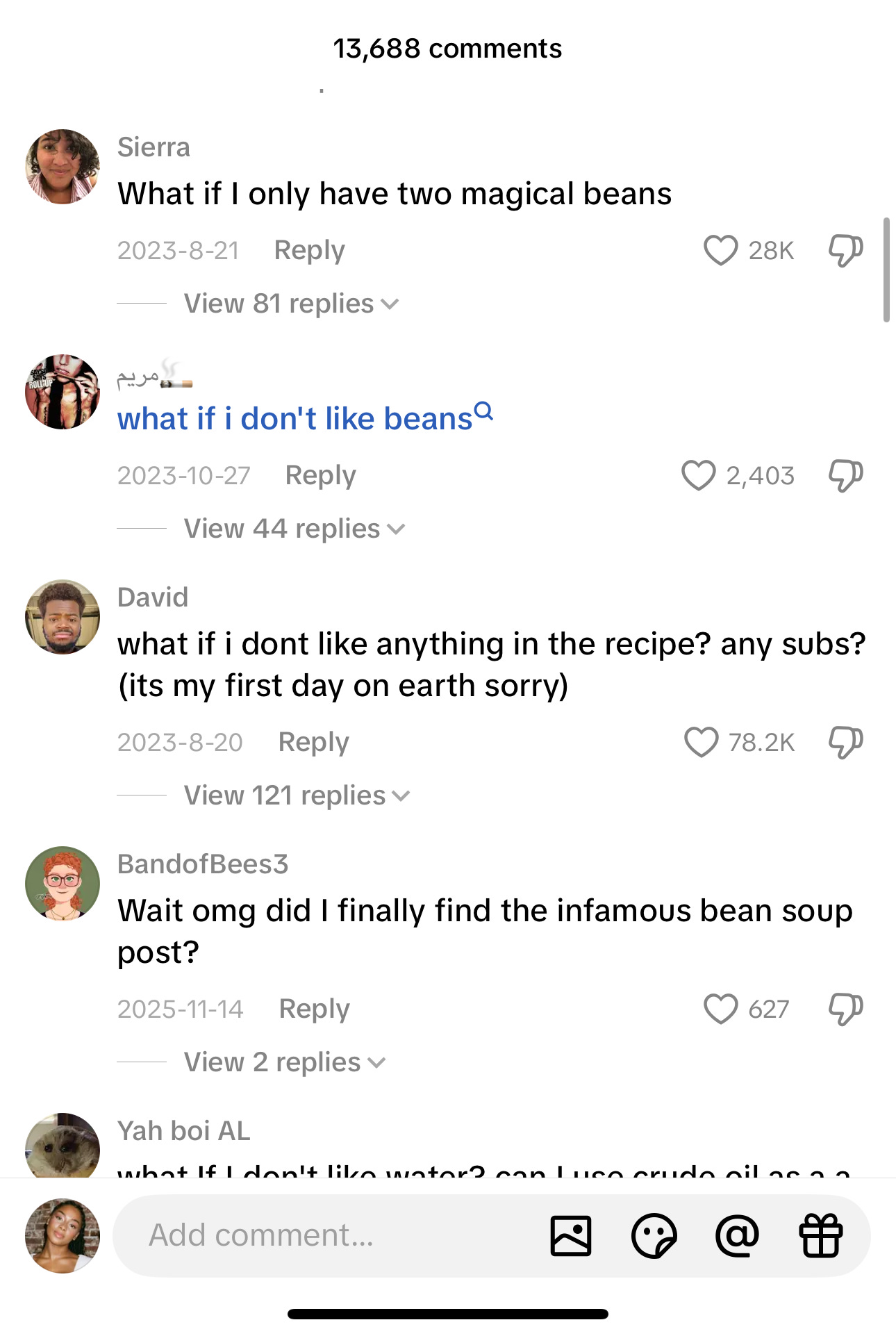
A lot of this comes from a misunderstanding of what the “For You Page” actually means. People assume that because something appears on their feed, it must be tailored specifically to them. If they don’t like beans and a bean based recipe appears on their feed, it’s an attack on their digital diet. So when a video makes a general statement, they respond as if it were a personal attack. Say something like, “Most people diagnosed with a terminal illness will die,” and someone will inevitably reply, “Well actually my aunt’s boyfriend’s dog had that illness and lived for 30 years.”
Like… okay? Why has data become the villain? Is there not a difference between empirical and analytical?
So much of this behavior is rooted in contrarianism and a desire to feel smarter, more informed, more correct — all while hiding behind faceless, postless profiles. People who create nothing feel oddly entitled to tear down those who do. At that point, the issue isn’t disagreement, it’s derailment. These comments aren’t meant to add anything to the conversation. They exist to poke holes, to challenge the creator’s authority, to re-center the content around the commenter instead of the work itself. It’s not critique. It’s policing.
And this isn’t the same as people rightfully pushing back on misinformation or harmful content. It’s rarely about facts. It’s about control — about asserting dominance over the narrative of a video that isn’t yours. The goal isn’t to learn or clarify; it’s to invalidate.
This bleeds into what I’d call comment section catfights: endless, low stakes arguments where people attack each other or the creator just to prove a point. And often, that point is either meaningless or wildly devoid of nuance.
I experienced this firsthand when someone commented on my Project Pan video insisting it was actually an empties video, and that I clearly didn’t understand the difference. None of the products were empty. Most were brand new. But she doubled down, telling me I could “admit” I didn’t know what I was talking about. I responded, annoyed, and later apologized — but the whole exchange made something very clear.
It didn’t matter. The video still did what it was meant to do: show people a more chic, conscious way to consume. One person trying to “school” me over semantics didn’t change that.
And that’s the pattern. People engage not to understand, but to correct. To prove they know more. To negate rather than add. Everyone wants to teach, but no one wants to learn. You can say, “There are 365 days in a year,” and someone will rush in with, “Well actually, every four years theres 366” as if the exception invalidates the point.

At some point, the comment section stops being a place for dialogue and becomes a performance of intellectual one-upmanship. And the loudest voices are rarely the most thoughtful… just the most eager to be seen.
Now I would go into why it is important to fact check information you share but If you read all of this and you’re waiting for that part, you my friend are not a Chic,Conscious Consumer” but another form of CCC a Contrarian Comment section Contaminator. And I am happy you read this!
The Comment Section as A Market Place
The comment section also offers another kind of visibility — one that requires very little effort. When a video goes viral and you comment on it, you’re suddenly part of the spectacle. You start receiving likes, replies, notifications, attention. And attention, of course, attracts brands.
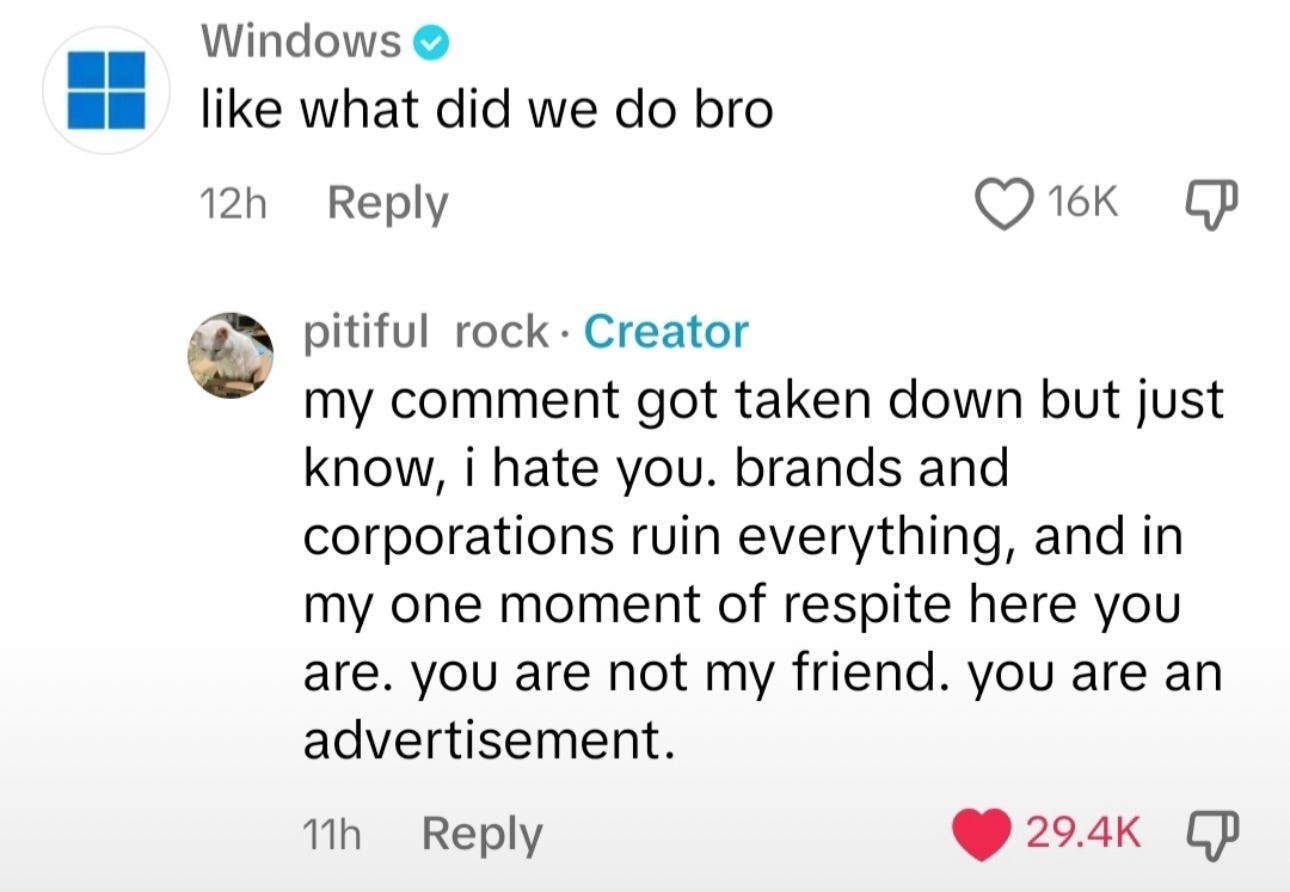
Late-stage social media has normalized brand presence in places that were once reserved for actual conversation. Trends like “seeing how many brands can comment before my flight lands” or “let’s see how many brands I can get to send me PR” have turned comment sections into a kind of digital playground for corporate visibility.
What started as playful has slowly become strategic. Brands now treat viral comment sections as low effort advertising real estate, a way to insert themselves into culture without paying creators or producing original content. While the Twitter beef between Wendy’s and McDonalds is quite entertaining, it raises a real question: at what point does brand participation become pure extraction? Brands will gladly occupy comment sections but never show up in your inbox.
More often than not, brands show up uninvited, capitalizing on a creator’s momentum without offering anything in return. The response from creators is usually half-joking “Ariana, what are you doing here?”or a hopeful nudge to be added to a PR list.
This extraction isn’t limited to brands. I noticed this while doing a deep dive into “PeptideTok.” Creators would post about their routines, and almost immediately, the comments would fill with “peptide pushers” or accounts swooping in to redirect curious viewers to their own links, discount codes, or bios. The pattern was predictable: genuine interest at the top, monetization underneath it.
It’s a way to attach yourself to virality without actually creating anything. This is especially visible as peer to peer, MLM style marketing becomes more normalized online. You’ll see it constantly: someone asks, “Where is this top from?” and a random account jumps in with an answer that’s either wrong, misleading, or conveniently linked to an affiliate page.
What’s unsettling is how seamlessly this behavior blends into the platform. The comment section no longer functions as a place for discussion — it’s become an informal marketplace, one where attention is the currency and credibility is often assumed rather than earned.
These two notes highlight a subtle shift, but an important one: creators do the labor, audiences supply the attention, and brands harvest the visibility.The comment section, once a space for dialogue, has become yet another marketplace.
What’s interesting is that the real discourse seems to no longer happen in the comment section at all. Lately, it’s become common for creators to prompt viewers to comment a specific word to receive more information via DM. A salad video will say, “Comment SALAD for the recipe,” and within seconds, a bot sends it directly.
On the surface, this feels efficient. But in practice, it drains the comment section of any real value. What could have been conversation turns into a wall of identical replies. The comments stop functioning as a space for exchange and instead become a tool for boosting engagement metrics.
And that matters, because comment sections function as what economists call a network externality or a system that becomes more valuable the more people meaningfully participate in it. Now, it’s the opposite. If the comments aren’t flooded with “SALAD,” they’re filled with copy + paste internet language that adds nothing to the discussion. There’s no observation, no reflection, no individuality — just repetition.
Over time, this reshapes what we even consider appropriate to say. Once a post has hundreds of identical comments, you stop engaging because there’s “nothing left to add.” TikTok’s five recycled phrases have already been deployed: Raw. Next question. I’m employed, what does this mean? Holding my little one tighter. Phrases that, in real life, would feel strange or even inappropriate (especially under something as serious as a video about miscarriage) but it’s become normalized simply because everyone else is saying them.
Language gets flatter. Tone gets louder. Subtlety disappears. Brashness wins.
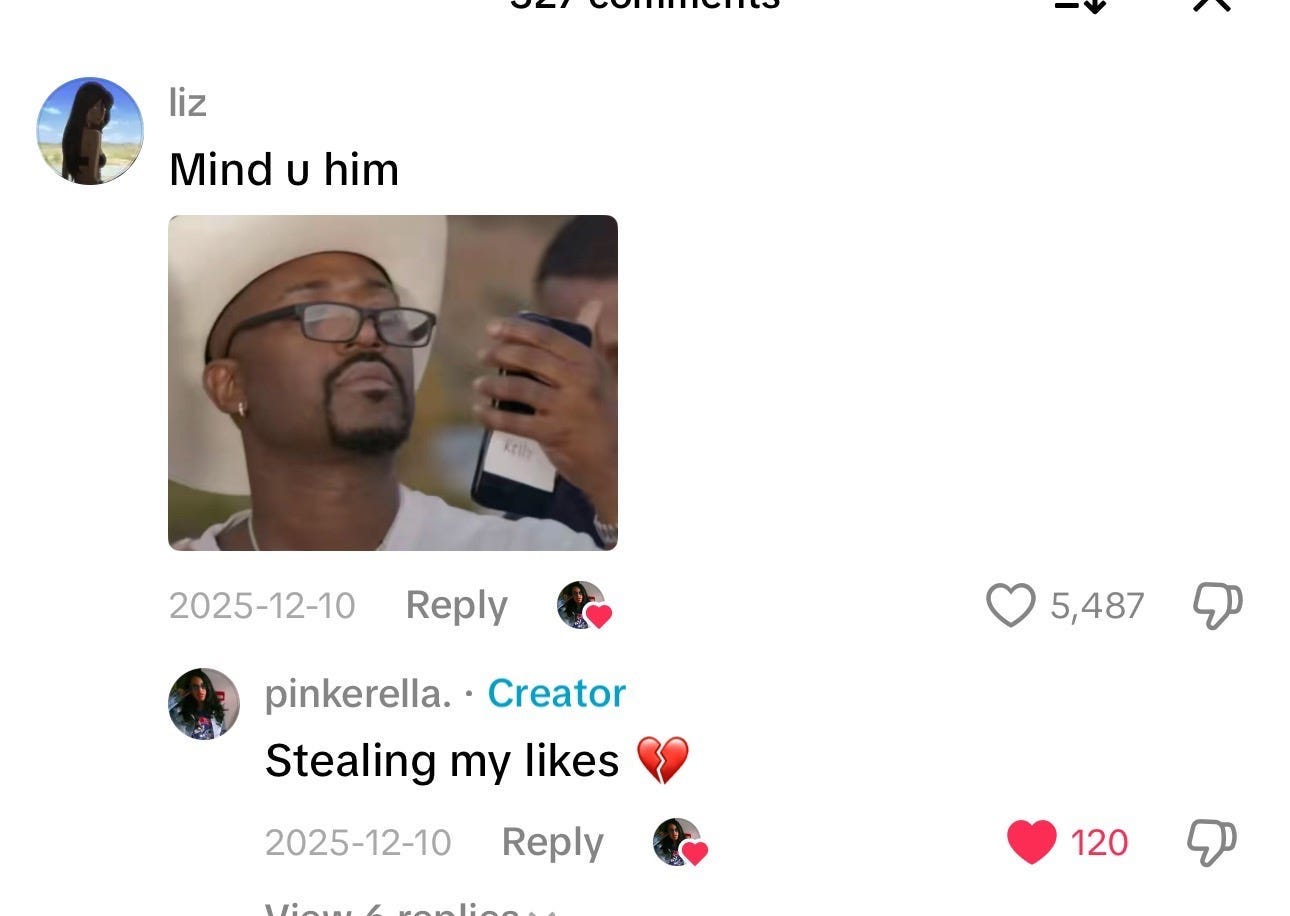
And within that ecosystem, a new kind of social media figure has emerged: the commenter as creator. As written content regains popularity — I’m looking at you Substack — wit becomes currency. The best comment, not the best idea, is what travels. You’ll see a viral reply and assume the person behind it must be a creator with a platform, only to click through and realize their entire presence online is reacting to other people’s work.
They don’t make content. They comment on it.
And that’s enough.
As people become more aware of social media’s value system *attention* they begin to realize they can choose where to place it. That’s why I like thinking about all of this through the lens of an economy. At its core, an economy is just the management of resources. In the traditional sense, that resource is money: how you earn it, spend it, save it, or waste it. In the attention economy, the scarce resource is you — your time, your focus, your energy.
You only get twenty-four hours in a day. How you spend them matters. What you choose to watch, engage with, or comment on matters. Media companies understand this deeply, which is why they’re constantly fighting to capture and reroute your attention. They integrate shopping features, AI tools, and seamless checkout experiences so your attention can move frictionlessly from scrolling to spending. And because we know that engagement is currency, commenting becomes a kind of transaction. Whether a comment is positive or negative, it still boosts visibility. It still feeds the algorithm. That’s why I can imagine a future where people intentionally withhold comments, not out of apathy, but as a form of refusal. A way of saying, I’m not giving you my attention. Especially in an era of rage bait, where outrage is engineered for engagement. Withholding attention becomes the digital equivalent of choosing a different coffee shop after one bad experience. It’s a silent vote. A personal boundary. A value based decision.
And for Dessert…
In a world built on constant commentary, I’ve reluctantly realized that I don’t have to have an opinion on everything. And even when I do, I don’t always need to express it. Comment section arguments are uniquely exhausting because they’re deeply personal and completely inconsequential at the same time. These exchanges just wouldn’t happen IRL and there’s no meaningful outcome. As I weigh out how to spend my attention the comment section has been the most important place to “restrict”.
And that’s all!
Thank you for consuming!
Phia
“Everyday is All There is”
The shift is real: the comment section is becoming the product, and “borrowed credibility” is the new distribution channel. That changes how brands should think about community, not just reach.